
So, What Is The Slow Life All About?

Snails. Monks. People who quit their jobs to live in vans. Expensive retreats where you're not allowed to talk for three days.
These are some of the things that come to mind when people hear "slow living."
Don't get us wrong, there's nothing wrong with any of those things. Retreats have their place, and van life works beautifully for some people. However, the way slow living is often portrayed misses what the practice actually is. In fact, it's usually packaged as an aesthetic or a lifestyle accessible only to people with certain privileges, rather than a way of approaching life that anyone can practice.
So what is slow living really about? It’s the actual practice that changes how your days feel.
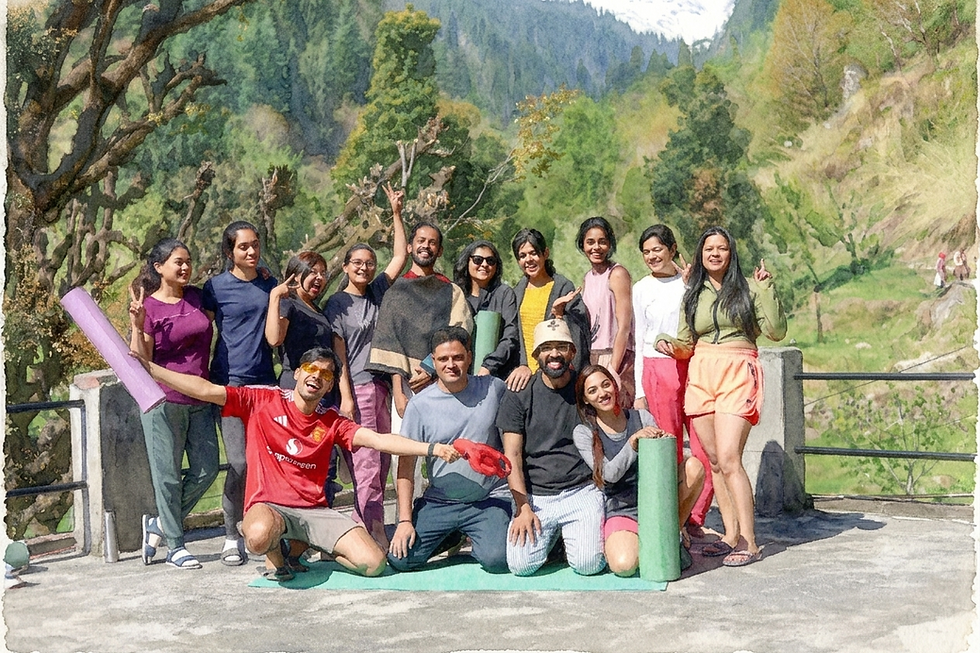
A perfect Slowcation morning centered around wellness and fresh perspectives.
Slow Living Rejects the Modern Belief That Faster Is Always Better
Sometimes going fast is fun. Sometimes it's necessary. And that's completely fine.
Slow living doesn't mean you need to practice intentionally slow micro-movements while making your morning coffee. It doesn't mean you can't enjoy the rush of a deadline or the thrill of moving quickly when it matters.
What slow living challenges is the unexamined belief that faster is always better. That speed equals success. That efficiency is the highest virtue.
There's a difference between eating a burger in your car between appointments and sitting down to dinner with people you care about. Both involve food. One nourishes you, the other just keeps you going. The difference is whether you're present for it.
Slow living is about living at the proper pace for what you're doing.
Efficiency has genuine value. But when we apply efficiency to everything—relationships, meals, conversations, experiences—we strip them of the very thing that makes them meaningful. Slow living focuses on effectiveness instead. On doing things well, not just quickly.
Choosing to live more slowly gives you a chance to notice what's actually important. To make decisions consciously instead of defaulting to whatever's fastest. To experience the moment you're in instead of just getting through it to reach the next one.
Slow Living Values Quality Over Quantity
More. Bigger. Faster. Better. These are some of the values that drive modern consumer culture.
Growth matters, of course. However, the way we've come to define "more" often misses a fundamental truth: more stuff doesn't create more satisfaction. In fact, research consistently shows that once basic needs are met, the pursuit of more tends to make people less happy, not more.
Our undisciplined chase for more is making us unhappy, unhealthy, and buried in debt. It's also been terrible for the planet we live on.
Slow living celebrates less but better. Whether it's eating less meat of higher quality, owning fewer clothes that are made to last, or having fewer commitments that you can actually show up for fully, the principle is the same. Quality before quantity.
This is about recognizing that having 30 mediocre things you barely use doesn't serve you better than having 10 things you genuinely value.
The same applies beyond stuff. Three deep friendships where people actually know you beat 300 social media connections where nobody does. One meal you actually taste beats five you eat while staring at a screen.
Less but better isn't a compromise, but an upgrade.
A Slow Lifestyle Makes Time and Space for What Matters
Slow living eliminates the non-essential to make room for what really matters.
This is where most people get it backwards. They think slow living means adding more things to an already full life: meditation practices, mindfulness exercises, slow morning routines.
Then they feel guilty when they don't have time for those either.
Slow living isn't something to add to your to-do list. It's a not-to-do list.
Think about what you'd do differently if you found out you only had a year left. Not in a morbid way, but genuinely. What would drop off your calendar immediately? What would suddenly seem absurd to worry about? What would you finally make time for?
Most of the things we think are important aren't. The crisis moments in life: serious illness, loss, major transitions, have a way of making that brutally clear. But we don't have to wait for a crisis to get that clarity.
When you remove everything that doesn't matter, you free up time, energy, and focus for the very few things that do. Your relationships. Your health. Work that feels meaningful. Service to something beyond yourself.
The guilt most people feel about saying no or letting things go comes from the belief that they should be able to do it all. Slow living rejects that belief entirely. You can't do it all. Nobody can. The question is: what deserves your finite time and energy?
Slow Living is Being Intentional With Our Attention
Your attention is your most valuable resource. Every platform, every app, every advertisement is fighting to capture it and keep it because they know: where your attention goes, so goes your life.
Most people spend more time choosing what to watch on Netflix than choosing what to give their attention to throughout the day. They hand it over by default, to notifications, to social media, to whatever's loudest or most urgent, and then wonder why they feel scattered and drained.
Thoughts are powerful. The ones you feed are the ones that grow. But most of us aren't choosing what to feed. Someone else, usually someone profiting from our attention, is choosing for us.
Slow living teaches you to be fiercely, unapologetically protective of your attention.
This doesn't mean becoming some zen master who never gets distracted. It means noticing where your attention is going and deciding if that's where you want it to be. It means building your life in a way that makes it easier to pay attention to what matters instead of constantly fighting against distraction.
For some people, that means quitting certain social media platforms. For others, it means turning off notifications or setting specific times for checking email. For others, it means learning to say no to commitments that would fragment their focus across too many things.
The specifics don't matter. What matters is recognizing that your attention isn't infinite, and treating it accordingly.
Slowing down creates the space to be intentional about where your attention goes instead of just letting it be pulled in whatever direction is pulling hardest in that moment.
Slow Living is Embracing Imperfection
Some of the most meaningful moments aren't the ones you'd photograph. They're messy and imperfect and sometimes full of pain.
Loss. Heartbreak. Failure. Grief. These aren't experiences anyone plans for or wants. But they happen. And when they do, being present for them, really letting yourself feel them is where depth comes from.
Slow living has never been about creating some perfect, curated life. It's about having the courage to experience life fully. The pain as well as the joy. The failures as well as the wins. The messy, uncomfortable, unfiltered moments as well as the beautiful ones.
When you're always rushing, you can avoid feeling things. You can stay busy enough that the hard stuff doesn't catch up to you. Until it does.
Slow living creates space for all of it, because avoiding pain means also avoiding depth. You can't selectively numb. If you turn off your capacity to feel grief, you also turn off your capacity to feel joy.
The slow life allows time and space for both.
Here's the thing: slow living isn't perfection. And there is no one way to do it.
Slow living is about finding the right tempo for your life. The proper pace. You get to choose that pace. Not some perfectly styled person on social media. Not a guru or a movement or a trend.
No one else gets to decide if your life is slow enough.
There are no rules. You can't do it wrong.
The only question that matters is: are you present for your life, or are you just getting through it?



Comments